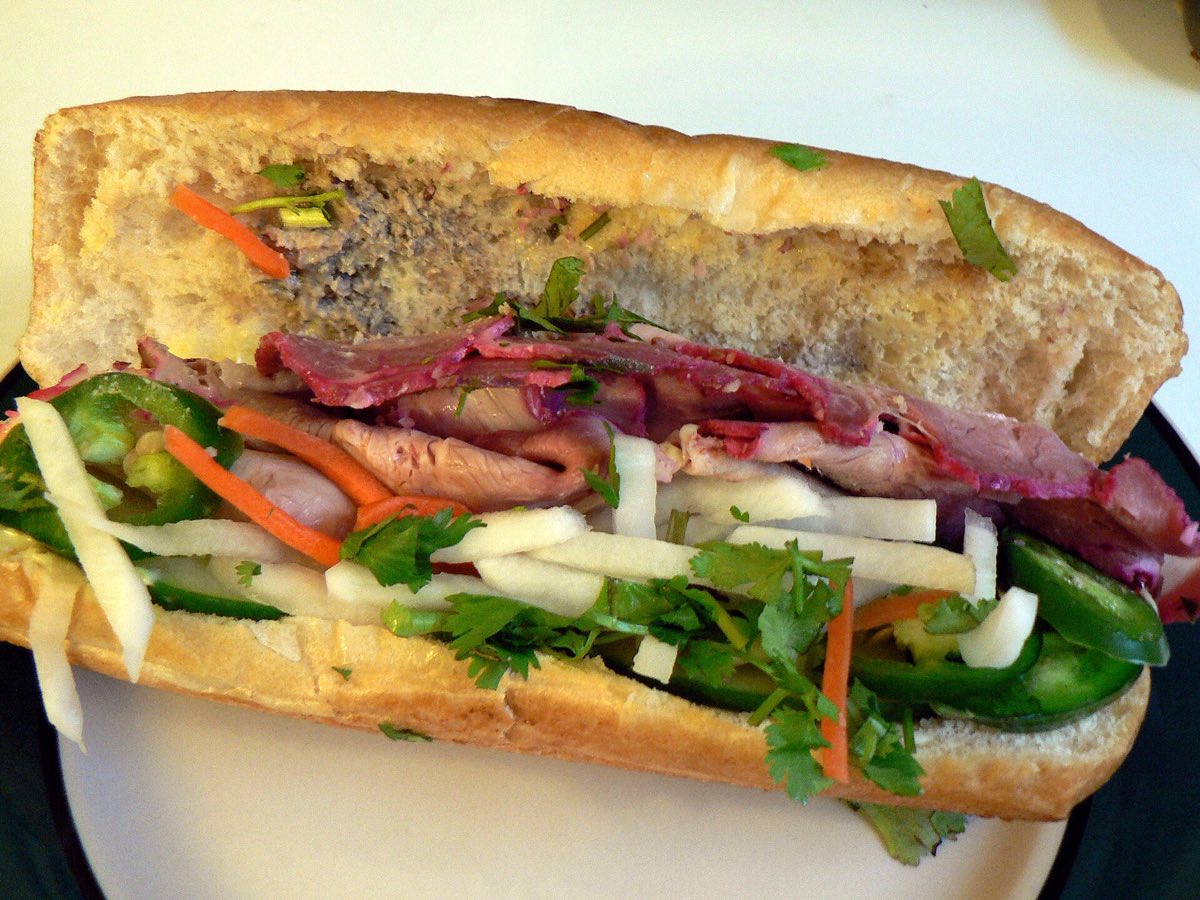
Banh Mi Que and the Da Nang Snack Canon: What to Eat Between Meals
The proper Da Nang meals are over by 13:00. The snack economy takes the afternoon and evening, and it is excellent. Bánh mì que is the local speciality — a skinny charcoal-crisped baguette filled with pâté and chilli, 5,000–12,000₫ (about $0.20–0.50) — with Bánh Mì Bà Lan at 62 Trưng Nữ Vương baking the best bread in town. Bánh tráng kẹp, grilled rice paper with pâté and quail egg, is the number one Da Nang food on TikTok and got a Michelin Selected listing in 2026 at Dì Hoa. Ốc hút — chilli-lemongrass snails at 25,000–50,000₫ a plate — is the 16:00 beer ritual. And Bún Bò Huế Bà Thương at 23 Trần Quốc Toản holds a Bib Gourmand 2025 after fifty-plus years of one dish, mornings only.
The pâté stick, and why it barely exists outside this city
Everyone knows Vietnamese bánh mì. Almost nobody outside central Vietnam knows the Da Nang version, which is a completely different object.
Bánh mì que means stick bread, and that is what it is: a baguette about the length of a forearm and roughly the diameter of two fingers, crisped over charcoal, split, and filled with pâté and chilli sauce. That is the whole thing. No cold cuts, no pickled carrot, no coriander — just very good bread, rich liver pâté and heat. It costs 5,000–12,000₫, which is twenty to fifty cents, and one is not enough. Two is a snack. Five is lunch.
It works because of the ratio. A normal bánh mì is mostly filling; this one is mostly crust, and the pâté is there to season the bread rather than the other way round. Eaten within a minute of leaving the coals it is one of the best cheap things in Vietnam. Eaten twenty minutes later in a hotel room it is a stale breadstick, so eat it standing at the cart.
The full-size bánh mì exists here too and the specialists are worth knowing: Mỹ Hạnh for heo quay (crackling roast pork), Ông Phú Đạt for heo nướng lu (pork roasted in a clay barrel), Hào Hào for chả bò (Da Nang's peppery beef sausage). And Cô Thông runs 24 hours, which in a city where everything Vietnamese shuts by 21:00 makes it disproportionately important — it is the entire late-night map alongside the Korean quarter and the food zone under the Trần Thị Lý bridge.
Where to get banh mi in Da Nang, by address
Six shops, five specialities. The first two are the ones to go out of your way for; the rest are worth knowing when you happen to be near them.
| Shop | Where | What it does | Price | Verdict |
|---|---|---|---|---|
| Bánh Mì Bà Lan | 62 Trưng Nữ Vương | The best bread in the city, and the reference bánh mì que. Everything here rests on the baking rather than the filling, which is exactly right for this format. | 5,000–12,000₫ | WORTH IT |
| Cô Tiên | 80 Trần Phú | The one with the queue. Central, easy to find on the riverfront side, and busy enough that the bread is never sitting around. Join the queue rather than looking for a quieter shop. | 5,000–12,000₫ | WORTH IT |
| Bánh Mì Cô Thông | City side | Open 24 hours. Not the best bánh mì in Da Nang and comfortably the most useful one, because at 02:00 the alternatives are Korean barbecue or nothing. | Street pricing | WORTH IT |
| Bánh Mì Mỹ Hạnh | City side | Heo quay — roast pork with the crackling left on. The full-size bánh mì rather than the stick, and the one to order if you want an actual lunch out of a baguette. | Street pricing | WORTH IT |
| Ông Phú Đạt | City side | Heo nướng lu — pork roasted in a clay barrel over coals, which produces a different texture entirely from the hanging-oven version. Worth seeking out if you have already done the standard ones. | Street pricing | WORTH IT |
| Hào Hào | City side | Chả bò — the peppery Da Nang beef sausage, which is a regional speciality in its own right and turns up in gift boxes at Han Market. | Street pricing | WORTH IT |
Checked August 2026. The published band for bánh mì que is 5,000–12,000₫; per-shop pricing for the full-size specialists is not separately documented, but bánh mì anywhere in Vietnam sits far below the 25,000–70,000₫ signature-dish band. Cash, and eat it at the cart.
Everything else worth eating between meals
This is the layer that fills the gap between a 07:00 breakfast and a 19:00 dinner, and it is the part of the Da Nang food scene that guidebooks skip entirely. Michelin did not skip it in 2026.
| What | Where | Why it matters | Price | Verdict |
|---|---|---|---|---|
| Bánh tráng kẹp grilled rice paper, pâté, quail egg | Dì Em, 252 Nguyễn Hoàng · Dì Hoa | Rice paper blistered over coals, smeared with pâté, dried shrimp, spring-onion oil and a quail egg, folded and dipped. The number one Da Nang food on TikTok, and Dì Hoa took a Michelin Selected listing in 2026 — which quietly validated the whole ram cuốn cải and grilled-rice-paper street genre. | Street-snack pricing | WORTH IT |
| Ốc hút chilli-lemongrass snails | Điện Phương, 304/1 Điện Biên Phủ · Hạnh, 31 Sư Vạn Hạnh · Phạm Hồng Thái at night | Small snails stir-fried hard in chilli, lemongrass and coconut milk. Hút means suck — you pull the meat out with your mouth. This is the afternoon-beer ritual and it is the most fun you can have for two dollars in this city. | 25,000–50,000₫ a plate | WORTH IT |
| Cút lộn xào me quail egg in tamarind | Lành, 129 Lê Đình Lý | Fertilised quail egg stir-fried in tamarind sauce, eaten with a spoon straight from the shell. The confronting item on this page, and genuinely delicious if you get past the idea. Usually sold alongside the snails. | Street-snack pricing | DEPENDS |
| Bún bò Huế | Bà Thương, 23 Trần Quốc Toản | Bib Gourmand 2025 after fifty-plus years of one dish. The spicy lemongrass-and-shrimp-paste beef soup from Huế, done properly — heavier and hotter than anything else in the Da Nang canon. Mornings only. | Bib band · 25,000–70,000₫ | WORTH IT |
| Bánh bèo, bánh nậm, bánh lọc Huế steamed rice cakes | Tâm's, 291 Nguyễn Chí Thanh · markets | Small savoury rice cakes steamed in bowls or wrapped in banana leaf, topped with dried shrimp and crackling. Sold by the set, eaten with a tiny spoon. Bánh Bèo – Bánh Đập took a Bib Gourmand in 2026. | Street-snack pricing | WORTH IT |
| Chè sweet soups and puddings | Chè Xuân Trang, 31 Lê Duẩn · Chè Liên | The dessert category — beans, jellies, coconut milk, fruit, crushed ice, in a dozen combinations and colours. Chè Liên is a Hải Châu institution. The correct thing to eat after ốc hút. | Street-snack pricing | WORTH IT |
| Kem bơ | Bắc Mỹ An Market — Kem Bơ Cô Vân, since 1992 | Blended avocado over coconut ice cream. The best cheap dessert in the city and part of the same viral snack economy as bánh tráng kẹp. Full detail on the markets page. | 8,000–30,000₫ | WORTH IT |
| Get taken to all of it | Seven stops, with a driver | The snack shops are scattered across the city side and none of them are near your hotel. This is the one food-tour use case that genuinely beats doing it yourself, because the addresses are unwalkable as a set. | Compare food tours | WORTH IT |
Checked August 2026. Where a price band is published in our sources we have used it: ốc hút 25,000–50,000₫ a plate, kem bơ 8,000–30,000₫, bánh mì que 5,000–12,000₫. Bánh tráng kẹp, chè and the Huế rice cakes are not separately priced in any source we trust — all sit at street-snack level, comfortably under a dollar or two. One widely-circulated kem bơ name is too thinly sourced to print, so this page names only Cô Vân and Cô Cúc.
Oc hut is not a dish, it is how Da Nang spends the late afternoon
From about 16:00, pavements across the city side fill with low plastic tables, plates of snails and crates of beer. This is the most local thing you can do here and it costs almost nothing.
Ốc covers a whole family of shellfish and ốc hút is the signature preparation — small snails stir-fried hard with chilli, lemongrass, garlic and coconut milk until the sauce clings inside the shell. Hút means to suck, and that is the technique: you put the open end to your mouth and pull, and the meat comes out with a mouthful of sauce. It takes three or four attempts to get right and everyone at the table watches you fail at it, which is part of the arrangement.
A plate is 25,000–50,000₫. Beer is cheaper. Groups order four or five different shellfish across a couple of hours and the bill for four people rarely reaches 400,000₫.
Where: Điện Phương at 304/1 Điện Biên Phủ and Hạnh at 31 Sư Vạn Hạnh are the named shops; Phạm Hồng Thái is the street that does it in volume after dark; and the Bắc Mỹ An Market stalls are the version you can reach on foot from the beach hotels. Cút lộn xào me at Lành, 129 Lê Đình Lý, is the traditional companion order.
Timing is the whole thing. This starts at about 16:00 and runs into the evening — precisely the window when the mì Quảng and bún chả cá shops have long since sold out and the dinner places have not opened. It is the answer to the dead afternoon.
Goi ca Nam O and be thui Cau Mong
Two dishes from the edges of the merged city that are worth knowing about, and that most visitors never encounter.
Gỏi cá Nam Ô is a raw anchovy salad from Nam Ô village at the northern end of Da Nang, out towards the Hải Vân approach in Lien Chieu. Raw fish cured briefly in lime and thickened with toasted rice powder, then eaten wrapped in leaves with a thick sauce. It is a genuine local speciality with a village attached to it, and it is raw fish — take that as it comes. Nam Ô is also known for its fish sauce, which is the same tradition seen from the other end.
Bê thui Cầu Mống is seared veal, a Quảng Nam classic from the village of Cầu Mống on the road south. The calf is cooked whole over straw and coals so the outside chars and the inside stays pink, then sliced thin and eaten with rice paper, herbs and mắm nêm — the same fermented anchovy sauce that defines the pork rolls. Since the July 2025 merger it is technically a Da Nang dish, which is a fair illustration of how much the city absorbed.
Neither is a casual walk-in from a beach hotel. Both are the kind of thing to fold into a day heading north to Hai Van or south towards Hoi An, which is how locals eat them too.
Da Nang snacks, practically
How much snacking should you build in?
The one category where a guide genuinely earns their money
Everything on this page costs between twenty cents and two dollars, so nothing here is about saving money. It is about geography: the snack shops are scattered across the city side, most have no English sign, and as a set they are not walkable. That is the specific problem worth paying to solve.
Da Nang snacks FAQ
What is bánh mì que?
A Da Nang speciality: a very thin baguette about the length of a forearm, crisped over charcoal and filled with pâté and chilli sauce, and nothing else. It costs 5,000–12,000₫ — twenty to fifty cents — and it barely exists outside central Vietnam. Bánh Mì Bà Lan at 62 Trưng Nữ Vương bakes the best bread in the city.
What is bánh tráng kẹp?
Rice paper grilled over coals until it blisters, spread with pâté, dried shrimp, spring-onion oil and a quail egg, then folded and dipped in a sweet-sour sauce. It is the number one Da Nang food on TikTok. Dì Em at 252 Nguyễn Hoàng is the well-known stall, and Dì Hoa took a Michelin Selected listing in 2026.
What is ốc hút and how do you eat it?
Small snails stir-fried in chilli, lemongrass, garlic and coconut milk, 25,000–50,000₫ a plate. Hút means suck: you put the open end of the shell to your mouth and pull, and the meat comes out with the sauce. It takes a few attempts. Điện Phương at 304/1 Điện Biên Phủ and Hạnh at 31 Sư Vạn Hạnh are the named shops.
What time does the Da Nang snack scene start?
About 15:00 for the grills and the kem bơ blenders, and about 16:00 for the snails and beer. It fills exactly the window when the famous breakfast and lunch shops have sold out and the dinner places have not opened — which is why the afternoon here is not the dead time it first appears.
Where can I eat in Da Nang at 2am?
Bánh Mì Cô Thông runs 24 hours, the food zone under the Trần Thị Lý bridge trades to about 02:00, and the Korean quarter on Phạm Văn Đồng serves barbecue until roughly 03:00. That is essentially the entire late-night map — Vietnamese kitchens here close far earlier than visitors expect.
Is Bún Bò Huế Bà Thương worth going to?
Yes, if you are up early. It is at 23 Trần Quốc Toản, has been making one dish for over fifty years, and took a Bib Gourmand in 2025. Bún bò Huế is the spicy lemongrass and shrimp-paste beef soup from Huế — heavier and hotter than anything else in the Da Nang canon. It is mornings only.
What is gỏi cá Nam Ô?
A raw anchovy salad from Nam O village at the northern end of the city, out towards the Hai Van approach. The fish is cured briefly in lime, thickened with toasted rice powder and eaten wrapped in leaves with a thick sauce. It is raw fish and it is a genuine village speciality — best folded into a day heading north rather than made into a separate trip.
What is bê thui Cầu Mống?
Seared veal from Cầu Mống in old Quảng Nam, cooked whole over straw and coals so the outside chars and the inside stays pink, then sliced thin and eaten with rice paper, herbs and mắm nêm. Since Da Nang absorbed Quảng Nam in July 2025 it is technically a city dish, though it still sits on the road south towards Hoi An.
are scattered
across Hai Chau.
Trung Nu Vuong, Tran Phu, Dien Bien Phu, Nguyen Hoang, Su Van Hanh, Le Duan and Pham Hong Thai are all on the city side. Bac My An Market is the one snack cluster you can walk to from the beach. If your ideal afternoon is a plate of snails and a beer on a pavement rather than a sunbed, book across the river - Hai Chau rooms cost less than the $40-60 beachfront four-stars and every address on this page is a short bike ride away.
Compare Hai Chau hotels